Timber vs PVC plantation shutters
The most common question we get asked, and the answer is almost never one or the other. Most Sunshine Coast homes end up with both, and which room gets which is a decision with a right answer rather than a preference.
- Compared on eight criteria
- The yellowing question answered
- Room-by-room recommendation
The short answer
Both
Timber in the dry rooms, PVC in the wet ones. Timber has the depth of finish that makes a living room shutter read as joinery. PVC has no timber core to swell, which is the only thing that matters in a bathroom. Most quotes we write include both.
ComparisonWinner
Looks up closeDepth and warmth of finishTimber
Wet areasSteam, splash, humidityPVC
Cost per square metre$350-550 vs $450-700PVC
Colour rangePaint, stain, colour matchTimber
Wide panelsSpan before saggingTimber
CleaningWhat you can use on itPVC
Neither wins outright, which is why the room decides rather than the budget.
Head to head
The full comparison
Eight criteria that actually change the decision, with the honest answer on each.
| Timber (basswood) | Waterproof PVC | |
|---|---|---|
| Cost per m² installed | $450 - $700 | $350 - $550 |
| Appearance up close | Deeper finish, visible grain if stained | Very good in white, flatter under scrutiny |
| Moisture and steam | Fails eventually in a wet room | Completely unaffected |
| Colour options | Any paint colour, plus stains | Limited range, mostly whites and neutrals |
| Maximum panel width | Wider before an extra stile is needed | Narrower unless aluminium-reinforced |
| Weight | Lighter per panel | Heavier, especially reinforced |
| Cleaning | Dry cloth only, no standing water | Damp cloth, soap, whatever you like |
| Expected life | 20+ years in the right room | 20+ years in the right room |
The big objection
Do PVC shutters go yellow?
This is the single most common objection to PVC, and it deserves a direct answer: cheap PVC yellows, quality PVC does not. The difference is whether the material is UV-stabilised through its whole thickness or merely coated on the surface.
Surface-treated plastic degrades from the outside in. Once the treated layer breaks down under Queensland UV, the raw material underneath is exposed and starts to discolour, and because the change is in the material rather than on it, there is nothing to clean or recoat. That is what people have seen on cheap plastic blinds in a north-facing bathroom going yellow within a couple of summers.
UV-stabilised PVC has the inhibitor distributed through the material itself, so there is no treated layer to fail. It is the difference between a product built for this climate and one imported to a price. Ask any supplier this question specifically - whether the UV stabilisation is through the material or on the surface - because it is exactly where the cheap product gives itself away and most sales staff will not volunteer it.
Stained cedar can grey over many years in a position that gets strong direct UV, in the same way any timber does. Painted basswood does not, because the paint is the UV barrier. If you want a stained finish on a window that takes hard afternoon sun, we will tell you that at the measure rather than after.
The decision
Which material for which room
This is how we spec almost every Sunshine Coast home, and it is why most quotes have both materials on them.
| Room | Recommendation | Why |
|---|---|---|
| Living and family rooms | Timber | Seen up close daily. Finish depth matters most here. |
| Bedrooms and nurseries | Timber | Dry, protected, and the warmth suits the room. |
| Studies and dining rooms | Timber | Same reasoning - dry rooms with no exposure argument. |
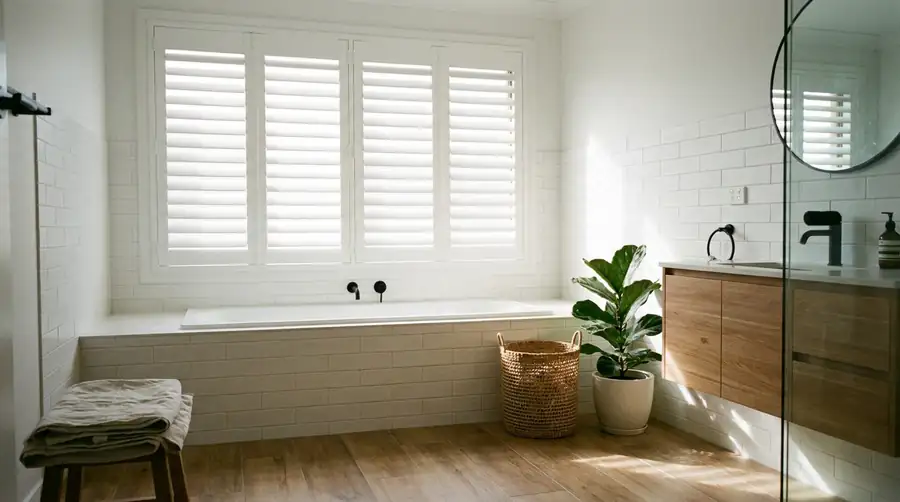
| Bathrooms and ensuites | PVC | Twice-daily steam. Timber will fail here eventually. |
| Laundries | PVC | Humidity plus splash, and it wipes clean. |
| Kitchen over the sink | PVC | Splash and cooking film. Cleanability decides it. |
| Poolside windows | PVC | Chlorine and splash, provided it is not getting direct weather. |
| Alfrescos and patios | Neither - aluminium | Direct weather and salt air need a third material entirely. |
Money
What the price difference actually means
PVC runs roughly $350 to $550 per square metre installed against $450 to $700 for painted basswood - call it 20 to 25 per cent less. On a single bathroom window that is a difference of a couple of hundred dollars, which is not the reason to choose it.
Where it becomes meaningful is on a whole-house quote. Putting PVC in the wet rooms rather than timber typically saves enough to upgrade the living areas to a better finish, or to cover the alfresco properly in aluminium. That is the trade worth making, and it is why we quote the house rather than the window.
What we would push back on is PVC throughout to save money. It quotes cheaper and it looks like a compromise in a living room, where the shutter is the thing your eye goes to every day. If the budget genuinely will not stretch, we would rather shutter fewer rooms properly than every room adequately.
In practice
Can people tell the difference?
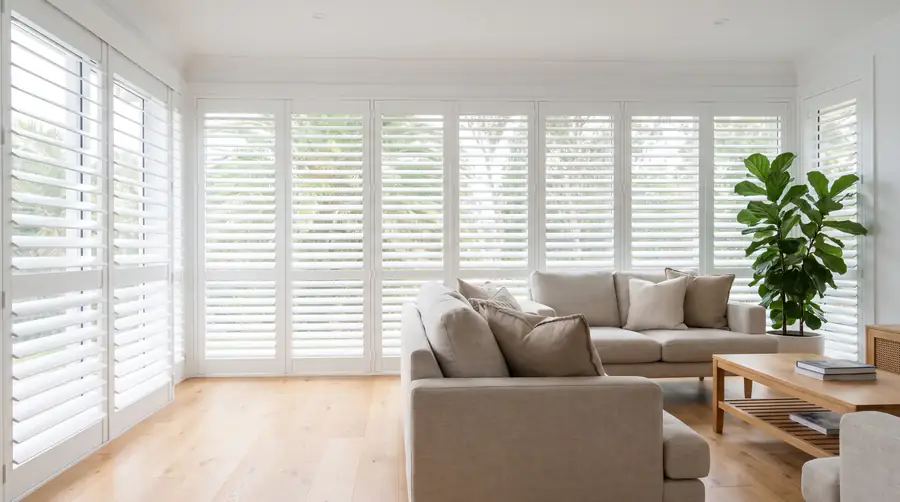
In a white painted finish, at normal viewing distance, most people cannot. That is the honest answer and it is why PVC in a bathroom is not a compromise - nobody is examining an ensuite window from thirty centimetres.
Up close, timber has a depth to its finish that PVC does not quite reach, and the edges of a timber louvre catch light differently. In a living room where you sit two metres from the window every evening, that difference is visible and it is worth paying for. In a laundry, it is not.
The one place the difference is unmistakable is a stained finish. There is no PVC equivalent to real grain under a tinted stain, so if that is the look you want, timber is the only option and the room needs to be dry enough to take it.
FAQ
Timber vs PVC questions
Should I choose timber or PVC plantation shutters?
Both, in different rooms. Timber in the dry rooms - living areas, bedrooms, studies - where the depth of finish is seen up close every day. Waterproof PVC in bathrooms, ensuites, laundries and over the kitchen sink, where steam and splash would eventually move timber no matter how well it is finished. Most quotes we write include both.
Do PVC plantation shutters go yellow?
Cheap PVC does, quality PVC does not. The difference is whether the material is UV-stabilised through its whole thickness or merely surface-treated. Surface treatments break down under Queensland UV and expose the raw material underneath, which then discolours permanently. Ask any supplier specifically whether the stabilisation is through the material - it is exactly where the cheap product gives itself away.
Are PVC shutters cheaper than timber?
Yes, roughly 20 to 25 per cent - about $350 to $550 per square metre installed against $450 to $700 for painted basswood. On a single window that is a couple of hundred dollars. On a whole-house quote it is usually enough to upgrade the living areas or to cover the alfresco properly in aluminium.
Can you tell the difference between timber and PVC shutters?
In a white painted finish at normal viewing distance, most people cannot. Up close, timber has a depth to its finish that PVC does not quite match, and that matters in a living room where you sit two metres away every evening. In a laundry it does not. Stained finishes are the exception - there is no PVC equivalent to real grain under a stain.
Can I put timber shutters in a bathroom?
We would not, and we will say so at the measure. A hot shower in a small ensuite is a full humidity cycle twice a day, every day. A painted timber shutter survives that only while its coating stays perfect, and one chip on a louvre edge lets water into the wood. It swells, lifts the paint further and eventually stops closing flat.
Which lasts longer, timber or PVC?
Both last twenty years and beyond in the room they belong in, which is the point. Neither material is inherently more durable - what shortens a shutter's life is putting it in the wrong room. Timber in a wet area fails early; PVC in a wide living room window can bow without reinforcement.
Is PVC the same as polymer, composite or faux wood?
Those names are used loosely and often interchangeably in the Australian market, and they do not describe a consistent product. What matters is not the name but whether there is a timber or MDF core inside the panel. A solid PVC panel with no core survives a bathroom; a timber-cored product with a wrap does not, whatever it is called.
What about wide windows - does the material matter?
Yes. Timber spans wider before it needs an extra stile, because it is stiffer for its weight. PVC needs a concealed aluminium insert through the stiles on taller and wider panels to stop them bowing. That is standard on our wide PVC panels, but it is worth asking any supplier about, because an unreinforced wide PVC panel will bow within a few summers.
Which material is easier to clean?
PVC, comfortably. It takes a damp cloth, dish soap and whatever else is under the sink, because there is no finish to lift. Timber should be kept dry - a barely-damp cloth for marks, dried off immediately - because water sitting on a louvre edge is what gets underneath the coating.
Ready to shutter your place?
Tell us about your windows and we'll book a free in-home measure and a fixed quote.
Get my free quote