Shutters vs blinds vs curtains
Three ways to cover a window, and each genuinely wins at something. This is the comparison written by someone who fits shutters, which is worth knowing - so we have been specific about where the other two are the better buy.
- Compared on nine criteria
- Where blinds and curtains win
- Room-by-room recommendation
The short answer
Depends
Shutters for rooms used in daylight where privacy matters. Blinds for cost, for true blackout and for rentals. Curtains for softness, acoustics and warmth. Plenty of good homes use all three.
If your priority isChoose
Light and privacy togetherThe daily annoyanceShutters
Lowest up-front costBudget firstBlinds
True blackoutNursery, shift workBlinds
Heat controlWest-facing roomsShutters
Softness and acousticsHard-surfaced roomsCurtains
Taking it with youRentingCurtains
Most homes are better off mixing than committing to one.
We have tried to be specific about where blinds and curtains beat shutters rather than vague, because a comparison that concludes "buy the thing we sell" for every criterion is not a comparison. Where the honest answer is not a shutter, we have said so.
Head to head
The full comparison
| Plantation shutters | Blinds | Curtains | |
|---|---|---|---|
| Cost, average window | $1,200 - $1,900 | $250 - $600 | $600 - $1,400 |
| Expected life | 20+ years | 5 - 10 years | 8 - 12 years |
| Light without losing privacy | Excellent - the defining advantage | Poor - privacy means closed | Poor, or two layers |
| True blackout | Good, not complete | Best - a single unbroken sheet | Very good with a blockout lining |
| Heat control | Very good - mass plus an air gap | Moderate | Modest - heat is already inside |
| Cleaning | Dust every few weeks | Dust, and fabric shows marks | Take down and wash |
| Humidity and wet rooms | Excellent in PVC | Fabric holds moisture and can mould | Poor - the worst option |
| Acoustics | Reflective - no softening | Minimal | Best - fabric absorbs |
| Takes it with you | No - fixed to the house | Sometimes | Yes |
The case for shutters
Where shutters win outright
Light and privacy at once
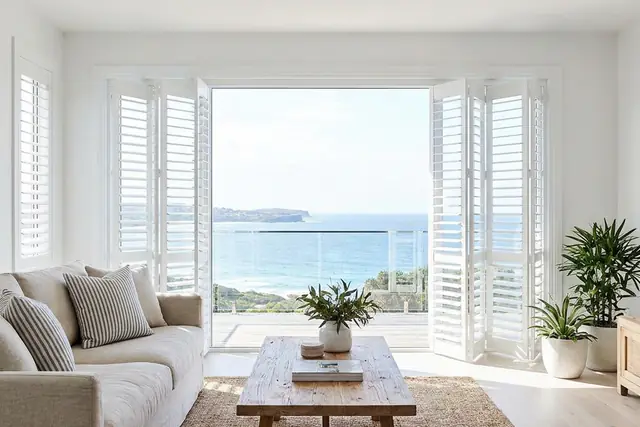
Tilt the louvres up and the room is bright while the sightline from outside runs into the underside of a blade. This is the one thing no blind and no curtain does, and it is the reason most people switch.
Rooms that get sun
A rigid panel with real mass, sitting close to the glass with a still-air gap behind it, stops far more radiant heat than a fabric sheet. On a west-facing Queensland living room the difference is not subtle.
Wet areas
Waterproof PVC in a bathroom does not care about steam. Fabric blinds hold moisture and eventually mould in a humid coastal bathroom, and curtains are worse again.
How the room reads
A fitted shutter is joinery and reads as part of the house. That is why shutters change how a room presents in a way a fitting hanging in front of the window does not.
The honest part
Where blinds and curtains beat shutters
Four situations where we would not recommend a shutter, and we say the same thing at the measure.
- 1
Blinds win on cost, and it is not close
A roller blind is a quarter to a fifth of the price of a shutter on the same window. If the budget is the constraint and every room needs covering now, blinds are the correct answer and there is no shame in it.
- 2
Blinds win on true blackout
A blockout roller is a single unbroken sheet with no gaps at all. A closed shutter is dark, not black - light comes around the frame clearance and through the hairlines between louvres. For a nursery or a shift worker, the blind wins.
- 3
Curtains win on acoustics and softness
Fabric absorbs sound. In a room with tiled floors, stone benches and hard walls, curtains take the echo out in a way a hard louvred panel simply cannot. They also add warmth to a room that reads as cold.
- 4
Curtains win if you are renting
Shutters are fixed to the house and they stay when you go. If you do not own the property, that settles it - and no landlord is reimbursing you for them.
Room by room
What we would actually put where
| Room | First choice | Why |
|---|---|---|
| West-facing living room | Shutters | Heat, glare and daily use all point the same way. |
| Street-facing bedroom | Shutters, split tilt | Privacy at eye level with light above it. |
| Nursery | Shutters plus a blockout blind | Looks and light control from one, true darkness from the other. |
| Bathroom or ensuite | Shutters in waterproof PVC | Fabric in a steamy coastal bathroom eventually mould. |
| Formal lounge or media room | Curtains, or shutters plus sheers | Acoustics and softness matter more than tilt control here. |
| Spare room used four times a year | Blinds | The benefit of a shutter is daily. This room is not. |
| Alfresco or patio | Outdoor aluminium shutters | Nothing else survives direct weather and salt air. |
| Rental property | Blinds | Durable, cheap to replace, and tenants operate them. |
Worth knowing
The two-layer problem
A large share of Australian homes run sheers plus blockouts on the same window. Sheers give daytime privacy and let light through; blockouts give darkness and night privacy. Two tracks, two sets of fabric, two purchases - because neither layer does both jobs.
That is the comparison people forget to make. A single shutter covers the ground both layers are covering, which changes the cost arithmetic considerably. Against $250 for a roller blind a shutter looks expensive; against a sheer plus a blockout plus two tracks it is much closer, and the shutter lasts twice as long.
The exception is the nursery or the room that has to be genuinely dark past sunrise. There, a shutter plus a slimline blockout behind it is a two-layer solution too - and we would rather specify that honestly than claim a shutter alone does something it does not.
The practical answer
Most homes should mix
The framing of shutters versus blinds versus curtains implies you pick one and fit it everywhere, and almost nobody should. The rooms in a house have different jobs, different exposures and different amounts of use, and the right covering follows from that rather than from a whole-house decision.
A typical Sunshine Coast home we quote ends up with timber shutters through the living areas and bedrooms, waterproof PVC in the bathrooms and over the kitchen sink, aluminium on the alfresco, curtains in a formal lounge for the acoustics, and a roller blind in the spare room nobody uses. That is not indecision - it is the correct answer applied per room.
It also means a shutter quote does not have to be all-or-nothing. We will happily quote three rooms and leave the rest, and we will tell you which three.
FAQ
Comparison questions
Are shutters better than blinds?
For rooms used in daylight where privacy matters, yes - a shutter lets you keep the room bright while nobody can see in, and no blind does that. For cost, for true blackout and for rentals, blinds win and we say so. The best homes usually mix: shutters in the living areas and bedrooms, blinds in rooms that get little use.
Are shutters more expensive than blinds?
Up front, considerably - roughly four to five times a roller blind on the same window. Over their life the gap narrows sharply, because a shutter lasts twenty-plus years against five to ten for a blind. The comparison people forget is against sheers plus blockouts on the same window, which is what many homes actually buy, and there it is much closer.
Which is better for blackout, shutters or blinds?
Blinds. A blockout roller is a single unbroken sheet with no gaps at all, where a closed shutter still passes a little light around the frame clearance and through the hairlines between louvres. A shutter is dark enough to sleep in comfortably at night; it is not black at 6am in a Queensland summer.
Are shutters better than curtains?
For light control, privacy and heat, comfortably. For acoustics and softness, no - fabric absorbs sound and a hard louvred panel does not, so in a room with tiled floors and stone benches curtains take the echo out in a way a shutter cannot. And if you are renting, curtains come with you and shutters do not.
What is best for a west-facing room in Queensland?
Shutters, and outdoor aluminium ones if the window opens onto an alfresco or patio. Low afternoon sun comes in almost horizontally under the eave, and a rigid panel with mass and a still-air gap stops far more radiant heat than fabric. Stopping the sun outside the glass beats stopping it inside by a wide margin.
Can I mix shutters, blinds and curtains in one house?
Yes, and most homes should. Rooms have different jobs, exposures and levels of use, and the right covering follows from that rather than from a single whole-house decision. A typical quote we write ends up with timber shutters in the living areas, PVC in the wet rooms, aluminium outside and a roller blind in the spare room.
What is best for a bathroom - shutters, blinds or curtains?
Waterproof PVC shutters. Fabric blinds hold moisture and eventually mould in a humid coastal bathroom, and curtains are worse again. PVC has no timber core to swell and takes a damp cloth with dish soap, which is exactly what a bathroom needs.
Do shutters or blinds last longer?
Shutters, by two to four times. Twenty years and beyond against five to ten for a blind, because there is no fabric to fade, no cord to fray and no mechanism on a replacement cycle. That is the whole basis of the cost argument - the blind is replaced twice in the time the shutter is not replaced once.
What should I use in a rental property?
Blinds, whether you are the tenant or the landlord. As a tenant, shutters are fixed to the house and stay when you go. As a landlord, tenants do not operate shutters the way owners do, damage falls on you rather than them, and the daily light-and-privacy benefit that justifies the cost is one you are not there to enjoy.
Ready to shutter your place?
Tell us about your windows and we'll book a free in-home measure and a fixed quote.
Get my free quote