Do plantation shutters keep heat out?
Yes, and more than most people expect. This is the guide to how they do it, which rooms in a Sunshine Coast home benefit most, and how shutters compare to the alternatives on the one job that matters here for eight months of the year.
- Written for the Queensland climate
- Compared against blinds and tinting
- Room-by-room advice
The short answer
Yes
Closed louvres stop direct sun before it reaches the glass and the closed panel creates an insulating air gap at the window. The effect is largest on west-facing rooms, which on the Sunshine Coast are the ones that become unusable by mid-afternoon in summer.
Where it helps mostEffect
West-facing living roomsAfternoon sun, low angleLargest
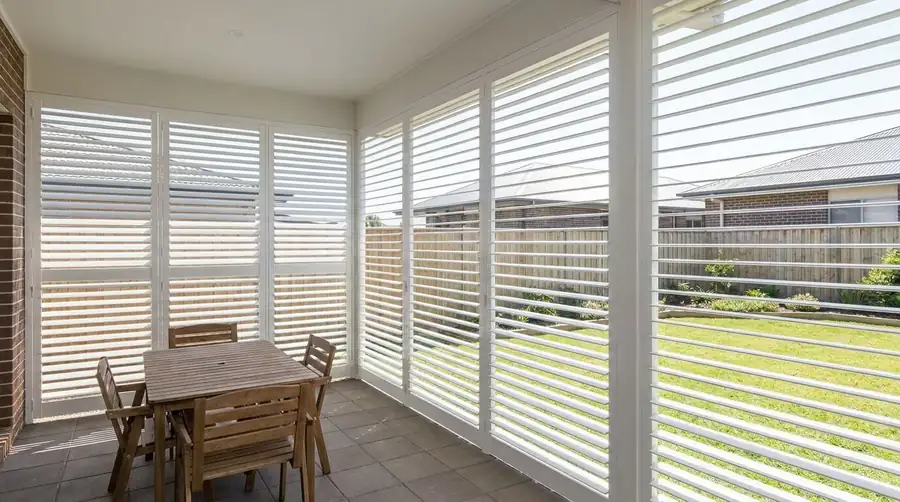
Alfrescos and patiosHeat stopped outside the buildingLargest
North-facing windowsHigh summer sun, long exposureLarge
East-facing bedroomsEarly morning heat and lightModerate
South-facing roomsLittle direct sun in QueenslandSmall
Every home is different. The measure is free and takes about half an hour.
Across the jobs we quote, the comment that comes up more than any other is that a western room went from unusable in the afternoon to the room people actually sit in. That is the practical version of everything below.
It reduces radiant heat gain through the window, which in a Queensland home is where most of the unwanted heat arrives. It will not fix an uninsulated roof, a west wall with no eave, or a room with no cross-ventilation.
The mechanism
How shutters actually reduce heat
Three separate things are happening, and only one of them is the thing people expect.
They stop sun before the glass
Radiant heat arrives as sunlight and turns into heat when it hits something solid. A closed louvre intercepts that light at the window instead of letting it land on your floor, furniture and walls, which is where an internal blind is already too late.
The closed panel makes an air gap
A shut shutter sits a few centimetres off the glass, and that trapped layer of still air is a genuine, if modest, thermal buffer. It works in both directions, which is why a shuttered room also holds warmth better on a winter night.
Angled louvres redirect the light
Tilt them upward and daylight bounces off the ceiling into the room while direct sun is deflected back out. That is the trick no blind can do - you keep a bright room without the heat load that normally comes with it.
The order matters. Stopping heat outside the glass is far more effective than stopping it inside, which is why outdoor shutters on an alfresco or a west-facing window outperform any internal covering by a wide margin. Once the sun has passed the glass, the heat is already in the building and you are managing it rather than preventing it.
The local angle
Why this matters more on the Sunshine Coast
Queensland sun is high, intense and lasts most of the year, and Sunshine Coast homes are typically built to catch breeze and light rather than to exclude sun. Large glazed areas, stacker doors onto alfrescos and west-facing living rooms are the standard plan here, and all three are heat problems by December.
The specific offender is the western elevation in the afternoon. The sun is low, so it comes in almost horizontally, straight under any eave and deep into the room. An eave that shades a north window perfectly at midday does nothing at all for a west window at 4pm - which is exactly why so many Coast living rooms are fine all morning and unusable after three.
Add humidity and the problem compounds. A room that has absorbed heat all afternoon does not shed it quickly at night, so it is still warm when you want to sleep. Stopping the gain in the first place is far easier than removing it afterwards.
Room by room
Which rooms benefit most
| Room | Why it heats up | What we would specify |
|---|---|---|
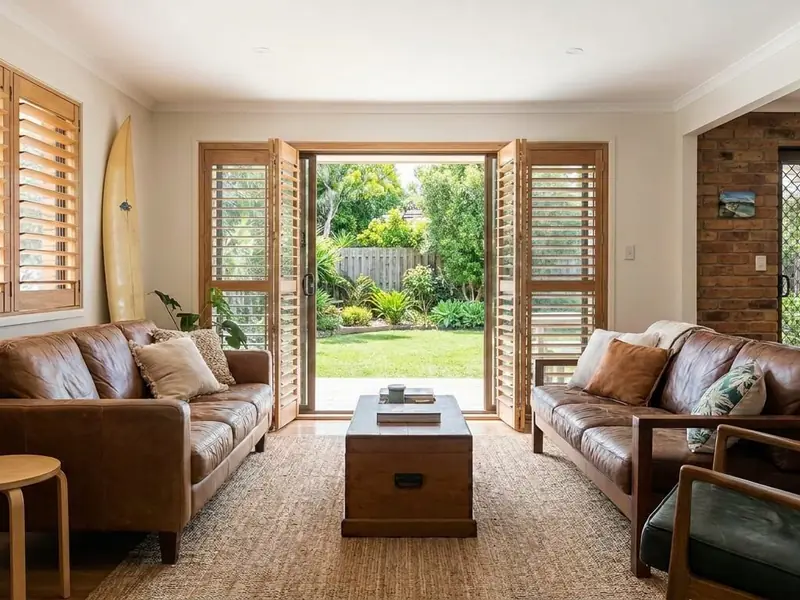
| West-facing living room | Low afternoon sun straight under the eave | Timber, 89mm louvres, hinged panels |
| Alfresco or patio | Direct sun on the slab and back into the house | Aluminium, outdoor, bi-fold or track |
| Stacker door to the west | The largest single glazed area in most homes | Aluminium outside, or timber inside |
| North-facing bedroom | High sun, long exposure through summer | Timber, hinged, split tilt if street-facing |
| Raked or gable window | High, large and completely unshaded | Fixed shaped panel with operable louvres |
| Bathroom or ensuite | Small window, minor heat contribution | Waterproof PVC, chosen for moisture not heat |
The comparison
Shutters versus the alternatives on heat
Honest comparison, including the two things that beat shutters.
| Option | Where it stops the heat | Verdict for a Queensland home |
|---|---|---|
| External aluminium shutters | Outside the glass | Best available. Heat never enters the building. |
| Internal plantation shutters | At the glass, with an air gap | Strong. The best internal option and the most controllable. |
| Window tinting | At the glass | Genuinely effective and cheap, but permanent - you cannot turn it off in winter. |
| Blockout roller blinds | At the glass | Good when down, but down means dark. No middle setting. |
| Curtains | Inside the glass | Modest. Heat is already through the window and warming the fabric. |
| Venetian blinds | Inside the glass | Similar tilt control to shutters, much less thermal mass and no seal. |
The honest reading: tinting and external shading beat internal shutters on raw heat rejection, and a good outcome often combines them. What shutters add is control - you can have the room bright and open in July and shut down in January, which a permanent film cannot do.
The other direction
They work in winter too
The same air gap that keeps heat out in summer slows heat escaping on a cold night. It is a smaller effect than the summer one, and on the Sunshine Coast winter is not exactly punishing, but it is real - a shuttered room holds its warmth noticeably better in the hinterland, where Maleny and Montville nights get down well below the coastal strip.
This is also why shutters suit a room with air conditioning. Whatever you have paid to cool or heat stays in the room longer, so the unit cycles less. Nobody should buy shutters as an energy-efficiency measure alone, but on a west-facing living room it is a genuine secondary benefit rather than a marketing claim.
Practical
Getting the most heat control out of them
- 1
Close before the heat, not after
Shut the western panels at lunchtime rather than at three when the room is already warm. Preventing gain is far easier than shedding it.
- 2
Angle up, not down
Tilting louvres upward bounces daylight onto the ceiling and deflects direct sun back out. Tilting down lets sun in low and defeats the purpose.
- 3
Shade outside where you can
On an alfresco or a west-facing door, external aluminium stops the heat before it reaches the building. That is always better than managing it inside.
- 4
Keep the airflow
Louvres tilt with the window open behind them. Shading plus cross-ventilation is the combination that actually works in a humid climate.
FAQ
Heat and insulation questions
Do plantation shutters really keep heat out?
Yes, noticeably. Closed louvres block direct sun before it reaches the glass, and the closed panel creates an insulating air gap at the window. The effect is biggest on west-facing rooms, which in a Sunshine Coast summer are the ones that become unusable by mid-afternoon. Customers report this as the single biggest change more often than anything else.
Are shutters better than blinds for keeping a room cool?
Generally yes. A shutter is a rigid panel with real thermal mass that sits close to the glass and creates a still-air gap, where a blind is thin fabric hanging in front of the window. Both let you tilt, but only the shutter gives you a sealed panel. The bigger difference is that shutters let you keep the room bright while blocking heat, and a blockout blind only does that by making the room dark.
Are shutters better than window tinting?
Tinting rejects more raw heat, and it is cheaper. What it cannot do is turn off. A film that keeps your living room cool in January also keeps it dim and cool in July, and it does nothing for privacy or light control. The two work well together, and if heat is your only concern and budget is tight, tinting is the honest first recommendation.
Which rooms benefit most from shutters for heat?
West-facing living rooms first, by a wide margin, because low afternoon sun comes in almost horizontally under the eave. Then alfrescos and stacker doors, then north-facing rooms with long summer exposure. South-facing rooms in Queensland get little direct sun, so shutters there are chosen for privacy and looks rather than heat.
Do outdoor shutters work better than indoor ones for heat?
Considerably better, because they stop the sun before it reaches the building at all. Once light passes the glass, the heat is already inside and you are managing it rather than preventing it. On an alfresco or a west-facing door, powder-coated aluminium outside is the most effective thing you can do short of rebuilding the eave.
Will shutters reduce my air conditioning bill?
They will reduce the load on it, particularly in a west-facing room, because the unit is fighting less radiant gain and the air gap slows what you have paid to cool from leaking back out. We would not sell shutters as an energy measure on their own, but as a secondary benefit on the right room it is real rather than a marketing line.
Do shutters help in winter?
Yes, though it is a smaller effect. The same air gap that keeps heat out slows heat escaping on a cold night. It matters more in the hinterland around Maleny and Montville, where nights get well below the coastal strip, than it does two streets from the beach.
Can I keep the room bright and still block the heat?
That is the specific thing shutters do that almost nothing else does. Angle the louvres upward and daylight bounces off the ceiling into the room while direct sun is deflected back outside. You get a bright room without the heat load, which no blockout blind can offer because its only setting for heat is dark.
What louvre size is best for heat control?
The difference is marginal. 89mm is our most-specified size and does the job well. Wider 114mm louvres give a clearer view when open and slightly fewer gaps when closed; narrower 63mm louvres have more slats and therefore more edges. Choose the size on looks and window scale rather than on heat.
Ready to shutter your place?
Tell us about your windows and we'll book a free in-home measure and a fixed quote.
Get my free quote