Choosing a plantation shutter louvre size
Three sizes cover almost every window, and the choice changes the view out, the light in and how the shutter sits against the scale of the room. It is a bigger visual decision than the colour and people spend far less time on it.
- 63mm, 89mm and 114mm
- What each does to the view
- Which suits your window
The short answer
89mm
The most-specified size in Australia and the one we fit by default. Wide enough for a clear view out, narrow enough to suit a standard window without dominating it. Choose 114mm for large windows and a modern look, 63mm for small or traditional ones.
Louvre sizeBest for
63mmNarrow blade, traditionalSmall windows
89mmThe Australian standardAlmost everything
114mmWide blade, contemporaryLarge windows
We bring sample panels in every size to the measure.
Large living room windows in 114mm and small bathroom windows in 63mm is a perfectly normal specification, and it usually looks better than forcing one size everywhere. What matters is that windows you can see at the same time match each other.
The mechanism
What the blade width actually changes
Four things move when you change the louvre size, and only the first is obvious.
The view out
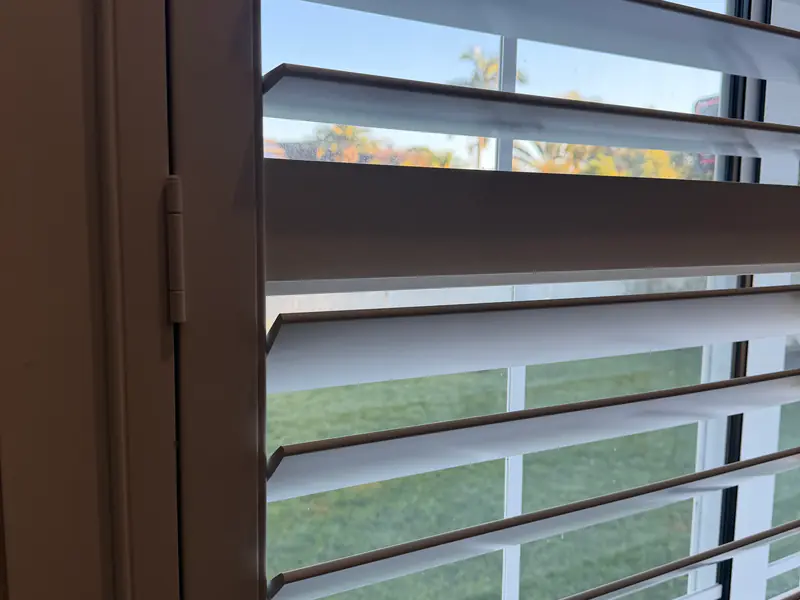
Wider blades mean fewer of them across the window, so when they are open you get bigger unbroken gaps to see through. On a window with a view worth having, this is the single strongest argument for 114mm.
How much light gets in
Fewer, wider blades means less total blade edge blocking light when open. The difference between 63mm and 114mm on the same window is small but visible on a grey day.
How it closes
Every louvre has a small gap where it meets the next one. Fewer louvres means fewer of those lines, so a wide-blade shutter closes down to a flatter, more solid-looking panel.
The proportion
This is the one people underestimate. A 114mm blade on a small bathroom window looks chunky and out of scale; a 63mm blade on a two-metre living room window looks busy and fussy.
Head to head
The three sizes compared
| 63mm | 89mm | 114mm | |
|---|---|---|---|
| Character | Traditional, fine | Balanced, classic | Contemporary, bold |
| View when open | More interrupted | Good | Clearest |
| Light when open | Least | Good | Most |
| Closed appearance | More visible lines | Balanced | Flattest, most solid |
| Best window size | Under about 900mm wide | Almost anything | Over about 1200mm wide |
| Common uses | Bathrooms, cottage windows, small sashes | The default across the house | Living rooms, stacker doors, feature windows |
If you take nothing else from this page: 89mm is right far more often than not, and it is the safe answer when you cannot decide. The two other sizes are for windows where scale specifically calls for them.
Room by room
What we would specify where
| Window | Louvre size | Why |
|---|---|---|
| Living room with a view | 114mm | Maximum clear view when open. The whole point of the window. |
| Stacker or sliding door | 114mm | Large panel area, and wide blades keep it from looking busy. |
| Standard bedroom window | 89mm | Balanced proportion, good blackout when closed. |
| Kitchen window | 89mm | Fewer blade edges to collect cooking film than 63mm. |
| Bathroom or ensuite | 63mm or 89mm | Small windows. 114mm reads as out of scale. |
| Queenslander sash windows | 63mm | Fine blades suit the period proportion. |
| Raked or gable feature window | 114mm | Large, high and seen at a distance. Wide blades read cleanly. |
The other question
Does louvre size affect privacy or blackout?
Barely, and less than people assume. A closed shutter of any blade width blocks the same line of sight - the louvres overlap when shut, and that overlap is engineered rather than incidental. Nobody sees into a room through a properly closed 114mm shutter any more than through a 63mm one.
Light is slightly different. Every louvre leaves a hairline where it meets its neighbour, so a shutter with more blades has more of those lines. In practice that means a wide blade closes marginally darker, though the difference is small next to the light that comes around the frame edges.
If total blackout is the priority - a nursery, or a bedroom for a shift worker - the answer is not a louvre size. It is a well-fitted frame with minimal clearance, and honestly a blockout blind behind the shutter if the room needs to be genuinely dark at 3pm. We will say that at the measure rather than overselling what a shutter alone does.
Worth knowing
Split tilt changes the calculation
A split tilt puts a second tilt control partway up the panel, so the top half and bottom half operate independently. Close the bottom for privacy from the street and leave the top open for light - which is exactly what a front-facing bedroom or a living room on a busy road needs.
It affects the louvre size decision because a split gives you a horizontal division line partway up the panel, and that line looks more deliberate with fewer, wider blades than with many narrow ones. On a tall window taking a split tilt, 89mm or 114mm generally reads better than 63mm.
The related option is a hidden tilt, where there is no visible centre rod at all and the louvres are moved by a mechanism concealed in the stile. That is a bigger change to how a shutter looks than the blade width is, and it is worth seeing in person before deciding.
Deciding
How to actually choose
- 1
Start with the window width
Under 900mm, lean narrow. Over 1200mm, lean wide. Between the two, 89mm is almost always right.
- 2
Ask what the window is for
A window with a view wants the widest blade the scale allows. A window that exists for light and privacy does not.
- 3
Look at the house, not the window
A 1920s Queenslander and a 2022 Peregian build carry different blade widths comfortably. Match the era.
- 4
Keep sightlines consistent
Windows you can see at the same time should match. Rooms you cannot see at once are free to differ.
And then look at real panels. Every sample board makes the sizes look closer together than they are on an actual window, which is why we bring full-size panels rather than a chart.
FAQ
Louvre size questions
What is the most popular plantation shutter louvre size?
89mm, by a clear margin, and it is what we fit by default. It is wide enough to give a good view out when open and narrow enough to suit a standard window without dominating it. If you cannot decide, 89mm is the safe answer and the one that suits the largest range of windows.
What is the difference between 63mm, 89mm and 114mm louvres?
Blade width, and with it the view, the light and the proportion. Wider blades mean fewer of them across the window, so you get bigger unbroken gaps to see through and slightly more light when open. Narrow 63mm blades read as traditional and suit small windows; 114mm reads as contemporary and suits large ones.
Which louvre size gives the best view?
114mm. Fewer, wider blades mean fewer interruptions across the glass when the louvres are open, so on a window with a view worth having it is the strongest argument for going wide. On a window that exists for light and privacy rather than outlook, the difference matters much less.
Are wider louvres better for blackout?
Marginally, and less than people expect. Every louvre leaves a hairline where it meets its neighbour, so fewer blades means fewer of those lines. But the difference is small next to the light that comes around the frame edges. If a room needs to be genuinely dark, the answer is a tight frame fit, not a louvre size.
Can I use different louvre sizes in the same house?
Yes, and it usually looks better than forcing one size everywhere. Large living windows in 114mm and small bathroom windows in 63mm is a normal specification. The rule is that windows you can see at the same time should match each other; rooms you cannot see at once are free to differ.
What louvre size suits a small window?
63mm, or 89mm if the window is borderline. A 114mm blade on a small bathroom or toilet window looks chunky and out of scale, because there are only a few blades across the whole opening. Narrow blades keep the proportion right on anything under roughly 900mm wide.
Does louvre size change the price?
Not much on its own. Wider blades mean fewer components per panel, which offsets the higher material cost per blade, so the sizes land close together. What moves a quote is the material, the panel configuration and the total area, not the blade width. Ask for the quote in both sizes if you want to compare.
What is a split tilt and do I need one?
A second tilt control partway up the panel, so the top and bottom halves operate independently - close the bottom for privacy from the street and leave the top open for light. It is worth having on front-facing bedrooms and any room on a busy road. On a window taking a split, 89mm or 114mm generally looks better than 63mm.
Ready to shutter your place?
Tell us about your windows and we'll book a free in-home measure and a fixed quote.
Get my free quote