Plantation shutters for light control and privacy
The reason most people buy shutters rather than blinds is that they do both jobs at once - a room that stays bright while nobody can see in. This is how that works, where the limits are, and the two things a shutter genuinely cannot do.
- Light and privacy at the same time
- Split tilt explained
- Honest blackout limits
The short answer
Tilt up
Angling louvres upward is the whole trick. Daylight bounces off the ceiling and fills the room while the sightline from the footpath runs into the underside of a blade. Bright room, no view in. No blind does this.
Louvre positionWhat you get
Fully openBlades horizontalFull view, full light
Tilted upThe everyday settingLight, no view in
Tilted downRarely what you wantLight, view in from below
Fully closedNight and afternoon sunPrivacy and heat control
All four positions are one movement of the tilt rod apart.
A closed shutter is dark, not black. Light comes around the frame edges and through the hairlines where louvres meet, and no shutter eliminates that. For a nursery or a shift worker's bedroom, the answer is a shutter for looks and daily use plus a blockout blind behind it. Anyone who tells you a shutter alone gives full blackout is overselling.
The mechanism
Why tilt beats raise-and-lower
A blind has one axis of control - up or down. Light and privacy arrive together and leave together, so a room that needs privacy has to be a room that is dark. That is the compromise everyone with roller blinds in a street-facing living room lives with.
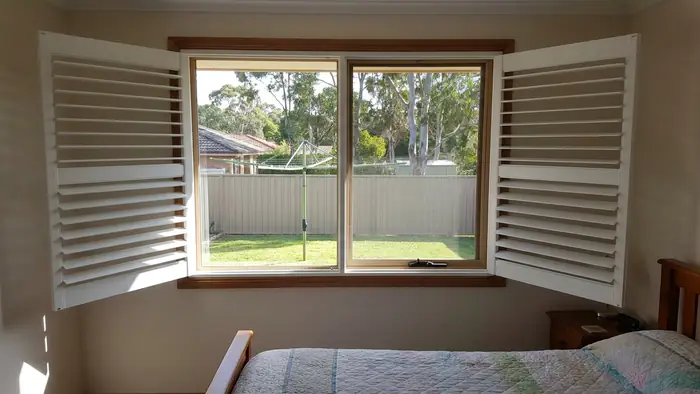
A shutter separates the two. The louvres rotate, so the amount of light entering and the angle at which someone outside can see in are controlled independently. Tilt the blades upward and the sightline from a person standing on the footpath runs straight into the underside of a blade, while daylight coming from above passes over the top and bounces off your ceiling into the room.
That is genuinely the single strongest argument for shutters over every other window covering, and it is the thing people notice within a week of installation - the living room is bright at 10am with nobody able to see in, and it took one movement of a rod.
The upgrade
Split tilt - the option worth asking for
A split tilt divides the panel into two independently controlled sections, usually at about two-thirds height. The bottom section closes for privacy while the top stays open for light and view, which is exactly what a street-facing room needs and exactly what a single-tilt panel cannot do.
It is the right answer on any window where someone can see in at eye level from outside - front bedrooms, living rooms on a footpath, any home on a corner block, and terraces or duplexes where the neighbour's window faces yours across a narrow gap. On the Sunshine Coast that describes a large share of newer estates in Birtinya, Baringa and Palmview, where block sizes are tight and windows face each other.
It adds a modest amount to the cost and it is worth it on the windows that need it. It is not worth it on a rear-facing window with a fence and a garden behind, and we will tell you which of your windows fall into which category at the measure rather than adding it to everything.
In practice
The four settings and when you use them
| Setting | Light | Privacy | When |
|---|---|---|---|
| Panels folded back | Maximum | None | A view you want, and nobody able to see in anyway. |
| Louvres fully open | Very high | Low | Rear-facing rooms, mornings, winter. |
| Louvres tilted up | High | High from ground level | The everyday setting for a street-facing room. |
| Louvres tilted down | High | Poor from below | Rarely useful - it lets sun in low and gives a sightline up. |
| Louvres closed | Low | Complete | Afternoon sun, sleeping, night-time. |
Tilted up is the setting most people end up living in, and it is worth a minute at handover to understand why. It is counter-intuitive - the instinct is to tilt down, away from the sun - and tilting down is the position that both lets low sun in and gives someone standing below a line of sight into the room.
The one people get wrong
Privacy at night is a different problem
Daytime privacy is easy because it is brighter outside than in. At night that reverses - your room is lit and the street is dark - and a partly-open louvre that gave complete privacy at 2pm gives a clear view in at 8pm. Anyone who has walked past a lit house at night knows exactly how visible the inside is.
The fix is simple and it is worth saying plainly: close the louvres fully at night. A properly closed shutter overlaps blade to blade and there is no sightline through it. What does not work is leaving them tilted and assuming the daytime behaviour carries over, which is the most common privacy complaint we hear and it is a habit rather than a product problem.
This is also why a shutter beats a sheer curtain for privacy by a wide margin. Sheers rely on the same brightness differential and become effectively transparent after dark, which is why so many homes end up with sheers plus blockouts - two layers doing one job that a shutter does on its own.
Straight answer
How dark does a closed shutter get?
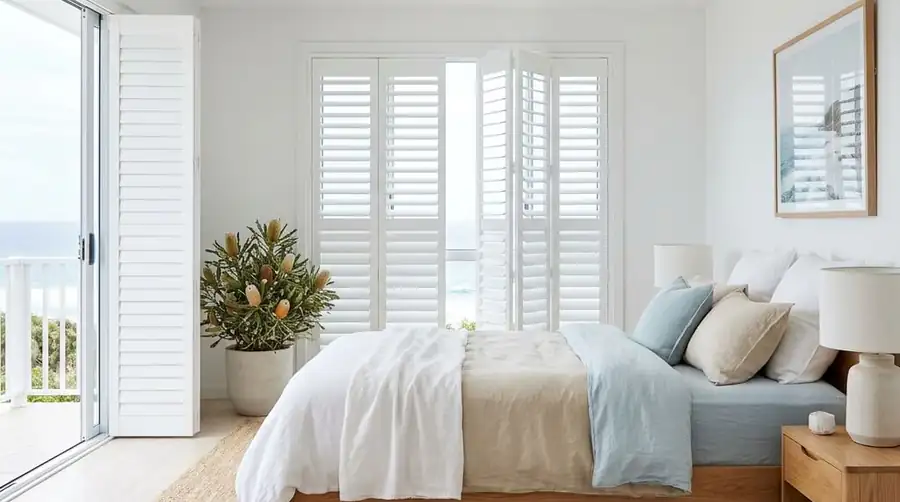
Dark enough to sleep in comfortably, and not dark enough to call blackout. A closed plantation shutter blocks the view completely and cuts the great majority of the light, but two paths remain: the hairline where each louvre meets the next, and the clearance gap around the frame that lets the panels move.
Both are small. In a bedroom at night the result is a genuinely dark room. At 6am in a Queensland summer, with sun on the glass, you will see the outline of the window. For most people that is fine and it is what they expected. For a baby's room, a shift worker, or anyone who needs to sleep past sunrise, it is not.
The honest recommendation for those rooms is a shutter for the look, the light control and the heat, with a slimline blockout blind fitted behind it for the nights it matters. It costs more and it works, and it is a better answer than pretending a shutter does something it does not.
Specifying
Getting light and privacy right at the measure
Walk the footpath and look in - that tells you which windows need a split tilt.
Check the neighbour's windows, not just the street. Narrow side setbacks matter more.
Note which rooms are used in daylight and which after dark - the answers differ.
Flag any room that needs to be dark past sunrise, so it can be planned properly.
Ask for a split tilt on the windows that need it, not on every window.
Ask about hidden tilt if you want the cleanest look - it changes the panel appearance.
None of this needs to be worked out in advance. It is what the measure is for, and half an hour walking the house is how a specification stops being a guess.
FAQ
Light and privacy questions
Can you see through plantation shutters?
Not when they are closed - the louvres overlap blade to blade and there is no sightline through a properly closed panel. When they are tilted, the angle decides it: tilted upward, someone at ground level is looking into the underside of a blade and sees nothing, while daylight still fills the room. Tilted downward, they can see in from below.
How do shutters give privacy without making the room dark?
By tilting the louvres upward. Daylight comes from above, passes over the blades and bounces off your ceiling into the room, while the sightline from a person standing outside runs into the underside of a blade. Light and privacy are on separate controls, which is the fundamental advantage over a blind that only goes up or down.
Do plantation shutters give privacy at night?
Only when fully closed, and this is the thing people most often get wrong. At night your room is lit and the street is dark, which reverses the daytime situation - a tilt that gave complete privacy at 2pm gives a clear view in at 8pm. Close the louvres fully after dark and there is no sightline at all.
Are plantation shutters blackout?
No, and nobody should claim they are. A closed shutter is dark, not black - light comes around the frame clearance and through the hairlines where louvres meet. It is dark enough to sleep in comfortably at night. For a nursery or anyone needing to sleep past a Queensland sunrise, fit a slimline blockout blind behind the shutter.
What is a split tilt shutter?
A panel divided into two independently controlled sections, usually at about two-thirds height, so the bottom can close for privacy while the top stays open for light and view. It is the right answer for street-facing bedrooms, living rooms on a footpath, corner blocks, and any home where a neighbour's window faces yours across a narrow setback.
Do I need a split tilt on every window?
No, and we would not quote it that way. It earns its cost on windows where someone can see in at eye level from outside. A rear-facing window with a fence and garden behind it does not need one. Walking the footpath and looking in is the quickest way to work out which of your windows do.
Are shutters more private than sheer curtains?
By a wide margin, particularly at night. Sheers work by the brightness differential between outside and in, so they become effectively transparent once your lights are on and the street is dark. That is why homes with sheers almost always end up adding blockouts too - two layers doing one job that a shutter handles on its own.
Which way should I tilt the louvres?
Up, almost always. Tilting upward bounces daylight off the ceiling into the room and blocks the sightline from ground level. Tilting downward is the instinctive move and the wrong one - it lets low sun in under the blades and gives anyone below a clear line of sight into the room.
Do shutters block light better than blinds?
When closed, comparably - a blockout roller will edge it for pure darkness because it is a single unbroken sheet. What shutters do that blinds cannot is give you a bright, private room, because a blind's only setting for privacy is down and down means dark. If a room is used in daylight, that difference matters far more than the last few per cent of blackout.
Ready to shutter your place?
Tell us about your windows and we'll book a free in-home measure and a fixed quote.
Get my free quote